

This coconut oil pie crust is rich, flaky, and amazingly delicious! Use this easy vegan pastry dough in just about any pie recipe. It's even freezer-friendly!

Every time I share a pie recipe, someone asks for my go-to crust recipe. I usually tell them to grab a store-bought crust — plenty of those are vegan (just avoid ones with butter or lard). But I get it: sometimes you want that rustic, homemade touch without the additives.
That’s why I created this easy coconut oil crust. Coconut oil makes a really delicious, perfectly flaky pastry dough. This crust is also totally vegan and works for just about any pie, whether it's a sweet dessert like vegan apple pie or vegan pumpkin pie, or a savory pie like my vegan pot pie or vegan quiche.
Jump to:
Coconut oil pie crust is also actually pretty simple to make, and only requires four ingredients. Let's talk about how it's done!
Ingredients You'll Need
Below you'll find a list of ingredients in this recipe, with notes and substitutions. Scroll all the way to the bottom of the post to see the full recipe, including the amount of each ingredient.
- Flour. Use all-purpose wheat flour for this recipe. Other varieties like whole wheat and gluten-free flour might work, but haven't been tested, so no promises!
- Salt.
- Coconut oil. If you want to avoid any coconut flavor in your crust, make sure to use refined coconut oil. I recommend this for savory pies. Unrefined coconut oil works if you don't mind the taste of coconut.
- Water.
Tip: Looking for a crust recipe with more conventional ingredients? Try my easy vegan pie crust!
How It's Made
Below is a detailed photo tutorial on how to make this dish. Scroll all the way down if you'd like to skip right to the recipe!
Before getting started, make sure your coconut oil is solid. Its melting point is right around room temperature, so unless you keep your house pretty warm, it should be good to go. If not, chill it for a bit.
Make the Dough
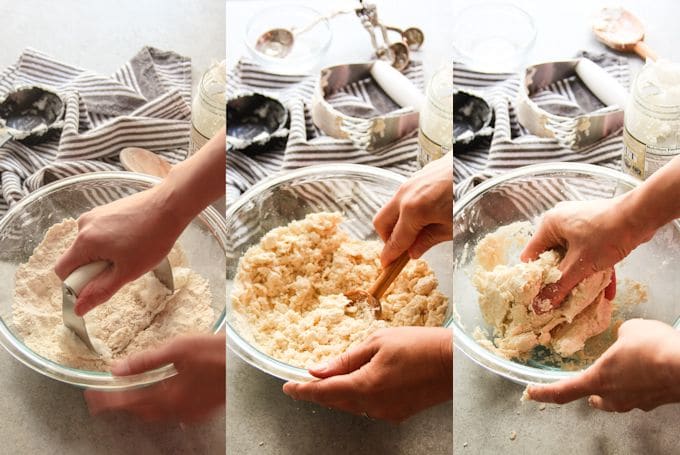
- Stir the flour and salt together in a mixing bowl. Next, add your coconut oil and cut it in. I used a pastry cutter to do this, but if you don't have one, try a fork or take a couple of knives and criss-cross them through the chunks of coconut oil to literally cut it into smaller pieces. The pieces slowly get smaller and smaller, all the while becoming coated with flour.
- Eventually, your mixture should look like fine crumbs. When you get to that point, start stirring in cold water (make sure it's cold!), a tablespoon at a time, just until the mixture forms into a dough that holds together. At this point I usually start mixing it with my hands.
Shape the Crust
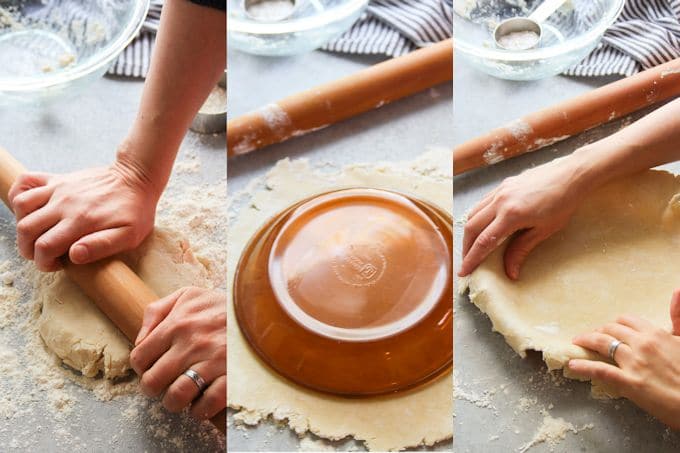
- Roll the dough out on a lightly floured surface to make your crust. Keep rolling until it's large enough for your pie.
- Use an inverted pie plate to measure the dough: you want the dough to extend an inch or so past the edge of the plate.
- Turn the plate over and lay the dough in the plate. Trim any excess dough from around the edges using a knife or kitchen shears.
- Tip: The crust will shrink a bit when you bake it, so leave a little more dough than needed to cover the edges of the pie plate when you trim it. Just a tiny bit is fine — ⅛ inch should be plenty!
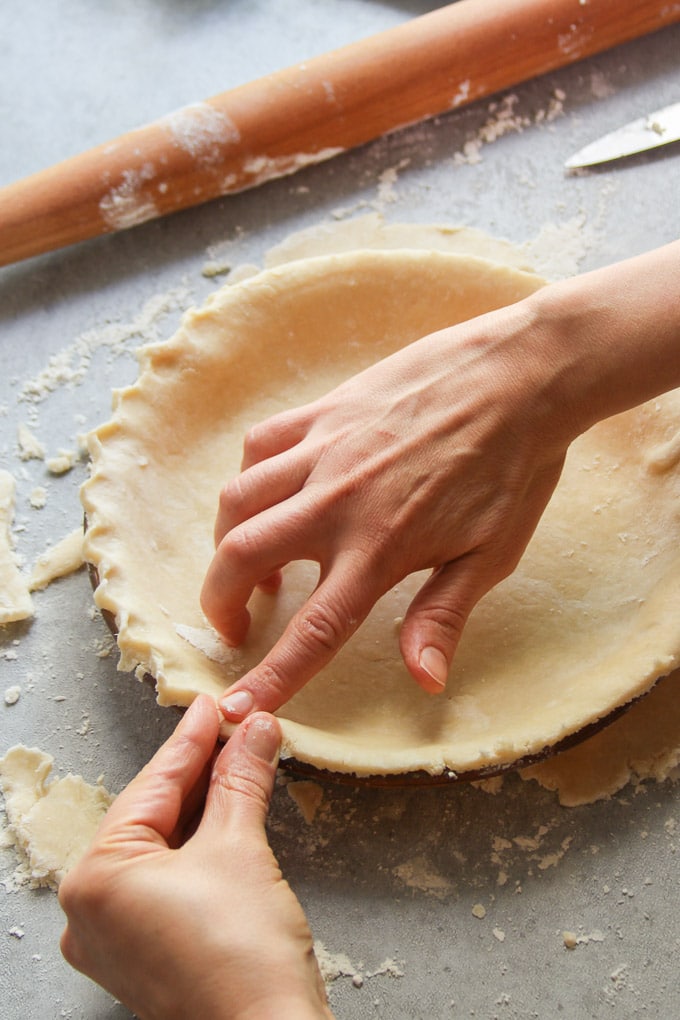
- Crimp the edges of the crust however you like. I like to make little V's using my fingers, but you can also crimp it with a fork if you prefer.
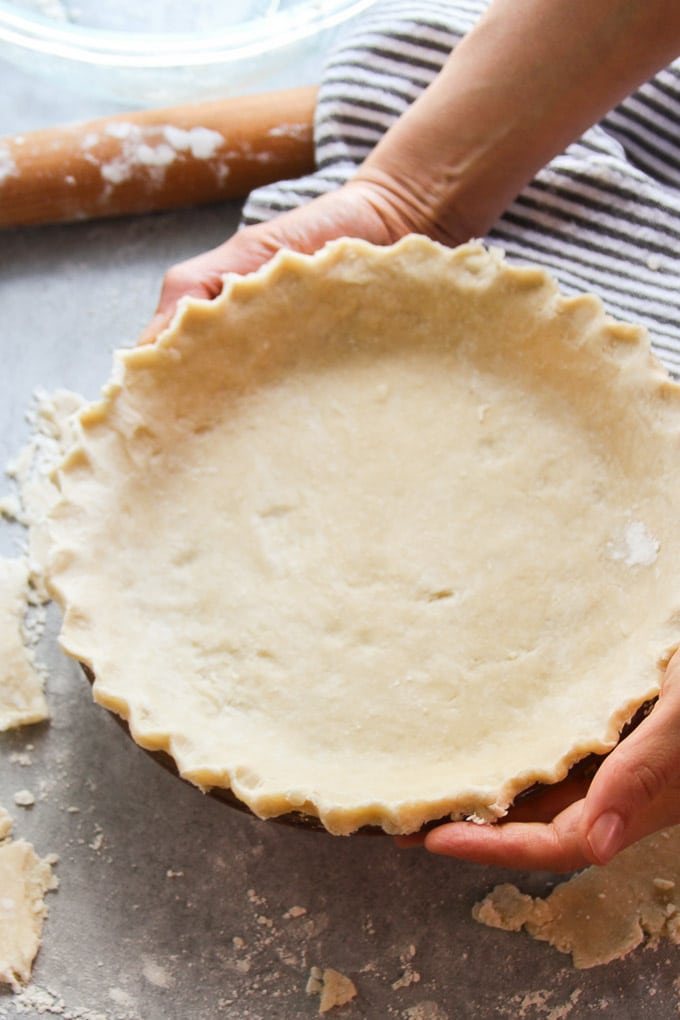
From here, it depends on what you plans are for the crust.
- To save it for later, seal it up in a freezer bag and place it in the fridge for up to 2 days or freeze it for up to 2 months.
- Chill your crust for at least a half hour before baking it.
- For a no-bake pie such as vegan banana cream pie, poke a few holes in the bottom, then line the crust with parchment paper or foil. Fill it with some rice, dried beans, or pie weights, and bake at 400° for about 30 minutes, until it's golden and flaky.
- For baked pies like vegan pumpkin pie, follow your pie recipe instructions, which may or may-not require pre-baking the crust before filling.
Tips for Success
- Be gentle with the dough. You want to avoid overworking it, which can over develop the gluten and lead to a tougher, chewier crust.
- Don't skip chilling. Chilling helps solidify those little bits of coconut oil, so you get a nice flaky crust, and it prevent the crust from shrinking during baking.
- Repair cracks and holes. If you get a crack or break when rolling or shaping your crust, try to gently work the dough together to repair it. If you have some excess crust, use it to make a patch.
Frequently Asked Questions
Possibly! I haven't tried it myself, but I think using an all-purpose gluten-free flour blend would be your best bet.
Yes, and it actually works great! Wrap the crust in plastic wrap and store it in the fridge for up to a day. For long term storage, freeze the crust. Once it's frozen solid, wrap it tightly in plastic or place it in a large freezer bag and return it to the freezer for up to three months.
Coconut oil can make pie dough a little finicky. If it’s too cold, the dough will be stiff, crumbly, or hard to roll. Unlike most pie crusts, this one actually works best when the coconut oil is at room temperature. If your dough feels too firm, just let it sit for a few minutes to soften up before rolling. You can also roll it between sheets of parchment paper to make things easier.
You sure can! Just double the recipe, and divide it in half. For the top crust, roll it slightly larger than your pie plate. Drape it over the fillings, pinch or crimp, and cut some ventilation holes before baking.
Vegan Pie Recipes
Need something to make with your crust? Try one of these vegan pies!
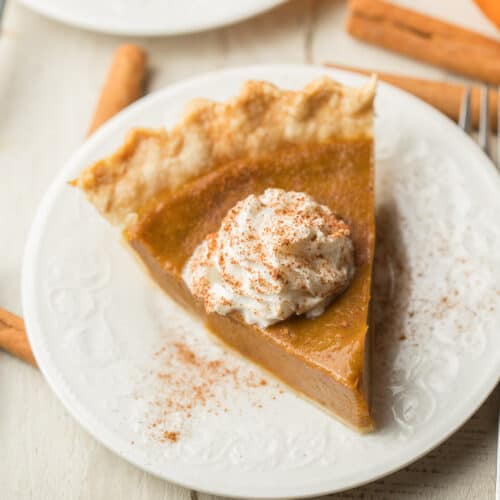
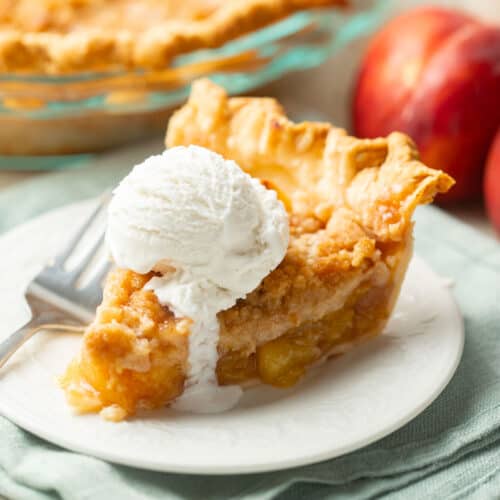
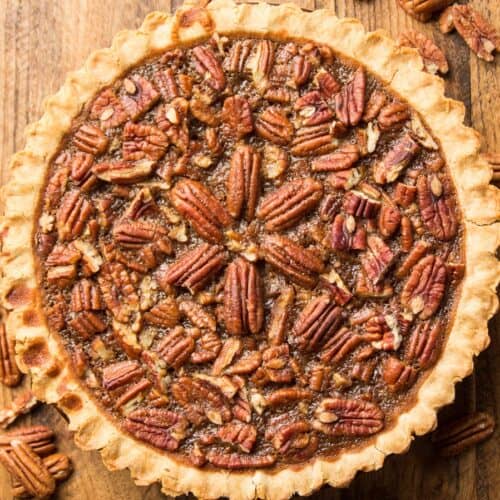
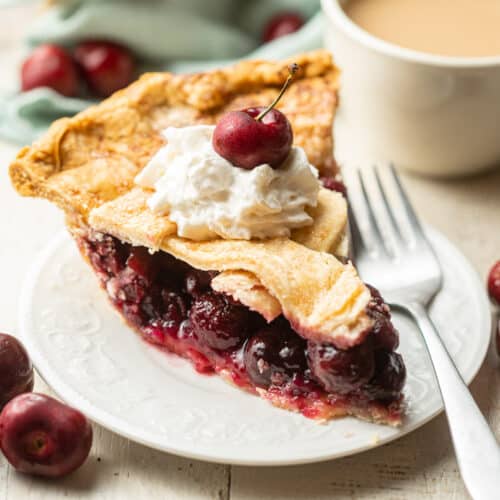
Like this recipe? If so, please stop back and leave me a review and rating below if you try it! Also be sure to follow me on Facebook, Pinterest or Instagram, or subscribe to my newsletter for more recipes like this one!
📖 Recipe

Coconut Oil Pie Crust
Ingredients
- 1 ½ cups all-purpose flour
- ½ teaspoon salt
- ½ cup coconut oil (solid state)
- 4 tablespoons ice cold water, plus up to 2 additional tablespoons
Instructions
- Stir the flour and salt together in a large mixing bowl. Add the coconut oil.
- Use a pastry cutter (or alternatively a fork or a couple of butter knives) to cut the oil into the flour. Continue until the mixture resembles fine crumbs.
- Stir one tablespoon of cold water into the mixture at a time, just until the mixture begins to hold together and form a dough.
- Continue mixing the dough until smooth, using your hands if needed.
- Roll the dough into a ball and transfer it to a lightly floured work surface.
- Use a floured rolling pin to roll the dough out. Keep rolling the dough into a circle until it's about an inch greater in circumference than the top of your pie plate. You can invert the pie plate on the rolled dough to measure.
- Carefully drape the dough inside of the pie plate, pressing it in so it conforms to the inside of the plate.
- Trim any excess dough from around the edges. Crimp the edges of the dough if you like.
- Place the shaped crust into the fridge to chill for at least 30 minutes before baking.
- Fill and bake the dough according to your pie recipe, or seal it up in a bag and freeze it for later.
Would you like to save this?
Nutrition
Nutrition information is provided as an estimate only and may vary based on ingredients, brands, portion sizes, and preparation methods.


Do you know whether gluten-free baking flour work for this recipe?
I think a one-to-one blend would work, but I haven't tried, so I can't say for sure. I'd love to hear how it turns out if you try it!
Hi,
Coconut oil seems to be a good alternative as I have had really hard crusts with butter in the past. I'm planning to use this for a pecan pie filling that also uses flour and needs to be baked. The recipe calls for about 50 minutes of baking. Do I still need to blind bake the crust or just add the filling and bake it all together?
No need to blind bake it unless your recipe instructs you to. 50 minutes should be more than enough time for the crust to fully bake. Enjoy!
Rock hard pastry using this recipe
Hi! How long and at what temperature do you recommend baking the crust with pie weights?
If it's for a no-bake pie, bake it at 400°F for 30 minutes. If you're blind baking it for a recipe where the filling also gets baked, I'd go with 400°F for 15 minutes, unless the pie recipe tells you to do something else. Enjoy!
I’m wanting to use this recipe to make pop tart crust for a toddler cooking project. Do you think it would work for that purpose?
I haven't tried it myself, but I can't see why not! I've had vegan pop tarts on my list of recipes to develop for a while not, so maybe I'll give it a shot and come up with something in the new year!
I followed the instructions but my dough was too sticky too really roll out successfully, let alone peel off the floured surface and put it into the tin to bake. When I was mixing the oil with the flour (with my pastry cutter), it had already started to make a dough-like texture. Any ideas or tips would be greatly appreciated. Thanks!!
It sounds like your coconut oil was melting while you were cutting it in. Is your kitchen very warm? Or was the coconut oil close to melting when you started? Sorry to hear this happened! Try chilling the coconut oil for a bit before getting started. It might also help to place your bowl in the freezer for a few minutes, especially if the kitchen is warm. I hope that helps!
does the dough need to chill before rolling it out? im making the custard pie recipe you have soon!
No need to chill the dough! It actually gets too hard to work with if you do. I hope you enjoy the pie!
Making this for the second time in about a month. Works like a charm. Helpful tip on the coconut oil: measure out the half cup while soft or liquid and toss in the fridge in advance. So much easier than scraping out a half cup of cold oil, let alone getting the lid open once it’s been in the fridge and essentially glued shut. I find the fridge-cooled oil works best and this makes it that much easier.
This pastry is really good - it turned out beautiful and flaky, and it was super easy to work with as well.
I used a fork to cut the oil into the flour - so before I did that I chopped the oil into slivers so it would be easier to cut.
I was able to use vegan butter and gluten free all purpose flour (Namaste brand) and it worked wonderfully.
I'm so glad it worked out! Thanks for sharing!
Not sure what I did wrong but my crust came out hard as a rock :( The dough never really came together was super crumbly I had to push it into the pan in pieces and stick it all together one piece at a time lol... This was my first time ever trying to make a pie crust from scratch so I'll try again. I followed the directions word for word so I'm not sure what I should do differently next time (?) I used this for a quiche that needed to bake at 325 for one hour. Can this crust be baked that long? Pre baking? So confused... thanks! xo
I'm sorry it didn't work out for you! If the dough was crumbly I'd suggest adding a bit more water until it holds together. It should be fine baking for an hour, and no need to prebake it. I hope that helps!
I am going to be making this crust for my raspberry glazed pie, but it doesn't get baked in the oven. So how do you suggest I bake the crust?
You'll need to poke some holes in the bottom of the crust with a fork or knife, then weigh it down - place a piece of parchment paper or foil in the center and add pie weights, dried rice or beans. Then just bake it at 400°F for about 3o minutes, let it cool and fill it! Enjoy!
I am staying away from wheat/white flour and sugar for health reasons. Is it possible to use Gluten Free flour to make this crust ?
Do you have any suggestions how to make a pie crust gluten free ?
I haven't tried a gluten-free version, but I think your best bet would be to substitute an all-purpose gluten-free flour blend like Bob's Red Mill or King Arthur!
This came out perfect. Thanks for a great recipes!
Yay! Glad it worked out for you!
I doubled the recipe and have added the max of water. The mixture is really crumbly, and not coming together. I wonder if the cold water hardened the coconut oil?
I stuck it in the fridge. It’s now very hard because it’s been in the fridge.
Maybe you can tell me what to do? I’m hoping you answer my comment. I’m new to vegan cooking. I tried coconut oil instead of Crisco because it’s healthier. Thank you.
Oh no! The water should be cold in order to harden the coconut oil - that's what gives your crust a flaky texture. I'd have to guess as to what went wrong, but maybe you didn't cut in the coconut oil enough before adding the water - I could see this happening easily with a double batch.
Actually, thinking about it now, I added both the water and coconut oil at the same time.
Isn’t suggestions? Can it be salvaged? I had a comedy of errors lately, trying to cook/bake with a hurt foot.
Thank you so much.
Oh that's definitely the problem then. Pastry is fussy and it's really important to follow the steps. I'm not sure if it can be salvaged at this point. If you can manage to form a dough out of it and add some sweetener perhaps you could make shortbread cookies, but I couldn't give exact instructions as to how to make that work.
Thanks for trying. Cookies sound great! At least I don’t have to Ross it all.
Hi Alissa,
I wanted to follow up with you. We were able to enjoy the crust! The dough sat in the fridge for about 2 weeks in a ziplock bag. Finaly I got stubborn. I didn't want to toss all that coconut oil out! I added water with a spray bottle until I got a workable dough!
I wasn't a flaky dough, but my husband was happy with his cherry pie. And that is what counts.
Thank you for your recipe. I will use it again. We like the faint taste of coconut in the dough.
I'm so glad it worked out! I really enjoy the little bit of coconut flavor as well. Thanks so much Judy!
If it comes out of the freezer like bread crumbs add ice cold water to bring it back together again. Don't work too much as the gluten will make the pastry tough.
If pie has a top crust as well, would you double recipe and divide just before rolling out, or make 2 batches, one for each crust?
You can just double the recipe! :)